
In 2014, when Nigeria handed its generation and distribution networks to private successor companies, the country made a bet: that competition and private capital would succeed where a state monopoly hadn’t. A decade on, the honest answer is it’s complicated — and the complication has always come down to one thing. Proof.
Proof that power was delivered. Proof that it was billed accurately. Proof that money collected reached the people owed it. PowerTech Advanced Business Technologies was built around that gap, starting with PowerCollect in 2015 — Nigeria’s first Automated Meter Reading and energy accounting platform, deployed across more than 1,000 bulk trading points and credited with cutting market settlement time from 25 working days down to 48 hours. Everything we’ve built since — PowerTrack, Grid Analytix, ARGUS for Lagos State — has been another layer of the same answer: instrument the grid, and let the data speak for itself.
Two products we’ve deployed most recently show where that mission has had to go next, because the industry’s questions have changed.
When “reliable power” became a regulatory promise, someone had to measure it
In April 2024, the Nigerian Electricity Regulatory Commission drew a hard line: customers on 481 designated “Band A” feeders were promised a minimum of 20 hours of power a day, in exchange for a higher tariff. It was a bet on measurable service, and DisCos had to prove they could keep it — NERC has already ordered several feeders downgraded out of Band A for failing to deliver. Then, months later, the ground shifted again: the Electricity Act 2023 gave states the legal right to run their own electricity markets. Seventeen states, from Lagos and Ogun to Enugu and Ekiti, have now taken over regulation within their borders, each with its own commission asking DisCos for its own answers.
That’s two different kinds of oversight — federal and state — both needing continuous, tamper-resistant, feeder-level evidence, at the same time, often over the same grid infrastructure.
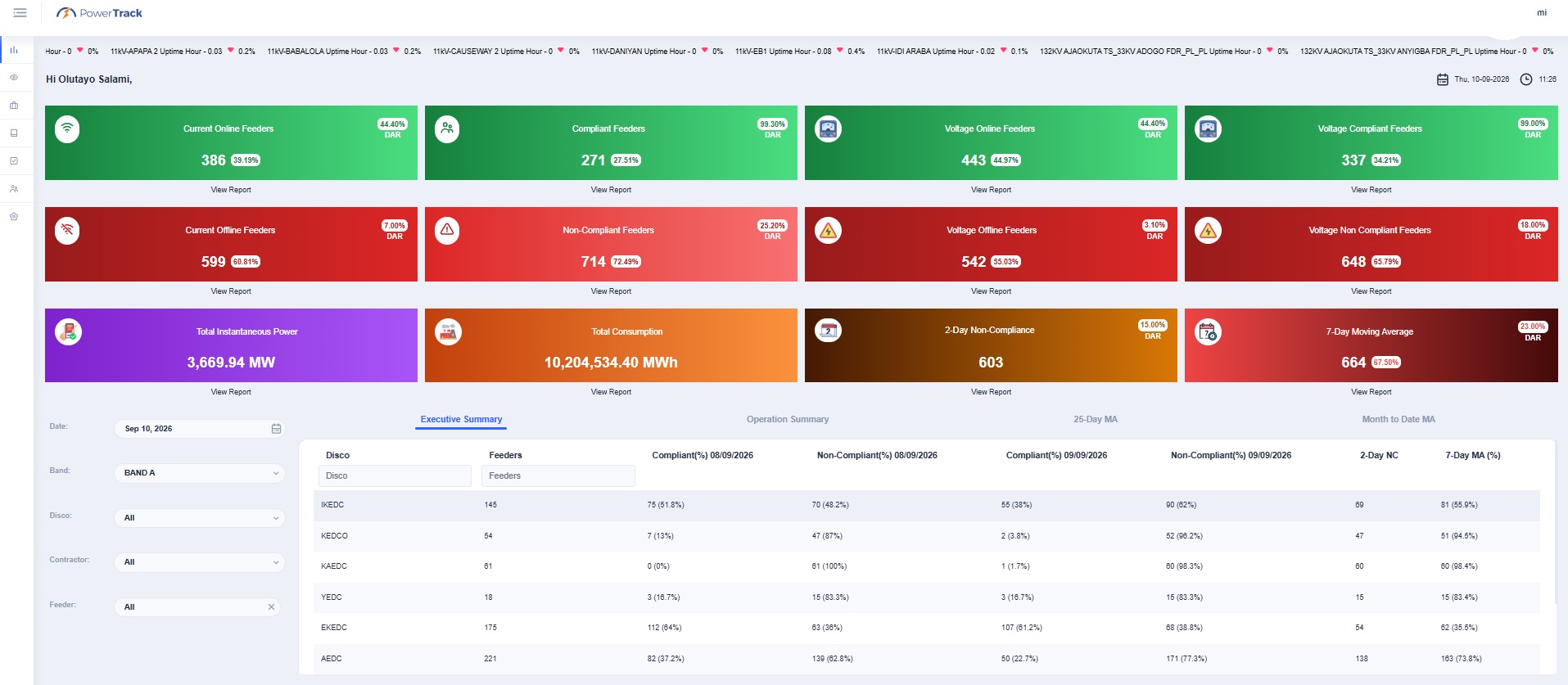
Genesis, PowerTech’s flagship IoT platform, is our answer. It sits at the grid edge and autonomously captures 1,440 data points per feeder every day, giving regulators a Band A compliance record that isn’t self-reported by the DisCo being measured. Because it’s built as a multi-tenant, federated system, a federal regulator and a dozen state regulators can each get their own isolated, configurable workspace on the same platform — instead of every new state commission needing to stand up its own monitoring infrastructure from scratch. In deployments so far, it’s supported a 90%+ NERC data-availability rate while cutting data-collection effort by 90% compared to legacy methods. Genesis doesn’t just report supply hours. It turns a regulatory promise into something that can actually be checked.
The other leak: government’s own unpaid power bills
The second problem is less visible but arguably more damaging. Nigeria’s Ministries, Departments and Agencies — the government’s own offices — are chronically behind on their electricity bills. As of late 2025, federal MDAs owed DisCos north of ₦100 billion, with Eko Electricity Distribution Company alone owed ₦66 billion. Industry-wide, DisCos failed to collect nearly ₦670 billion in billed charges in 2025, a 25% jump from the year before. Every naira of that is a naira DisCos can’t remit to NBET, the Nigerian Bulk Electricity Trading company that pays generators — so an MDA that doesn’t pay its bill ends up squeezing the entire value chain behind it.
Part of why that debt is so hard to shrink is that nobody has had a single, trusted view of what any given MDA site actually consumed versus what it was billed. PowerDash, PowerTech’s newest platform, is built to close exactly that gap. It reconciles metered consumption at MDA sites against billed amounts, gives MDAs, DisCos and regulators a shared real-time view of consumption and payment status, and enables automated remittance from DisCos to NBET through CBN or another designated settlement agent. Where PowerCollect once turned market settlement from weeks into days, PowerDash is aimed at doing something similar to the government-debt bottleneck: replace disputed guesswork with a shared, reconciled number everyone can act on.
Same instinct, ten years apart
What connects PowerCollect in 2015 to Genesis and PowerDash in 2024–2025 isn’t the technology stack — it’s the instinct. Nigeria’s power sector doesn’t suffer from a shortage of promises; NERC has made them, DisCos have made them, government has made them. What it has chronically lacked is a trustworthy record of whether those promises were kept. Every product PowerTech has shipped, from AMR meters at 1,000+ trading points to 27,000 streetlights monitored for Lagos State under ARGUS, has been another attempt to put a number where a promise used to sit.
The regulatory landscape keeps changing — new bands, new state commissions, new remittance mandates. That’s precisely why the mission hasn’t: build the instrumentation the industry needs to hold itself accountable, before the next set of promises gets made.
Sources: Vanguard — Band A tariff areas · Daily Trust — Band A feeder downgrades · Mondaq — Electricity Act 2023 & state markets · Energy News Network — state electricity commissions · Legit.ng — MDA debt to DisCos · NERC 2025 report — ₦669.5bn uncollected.
